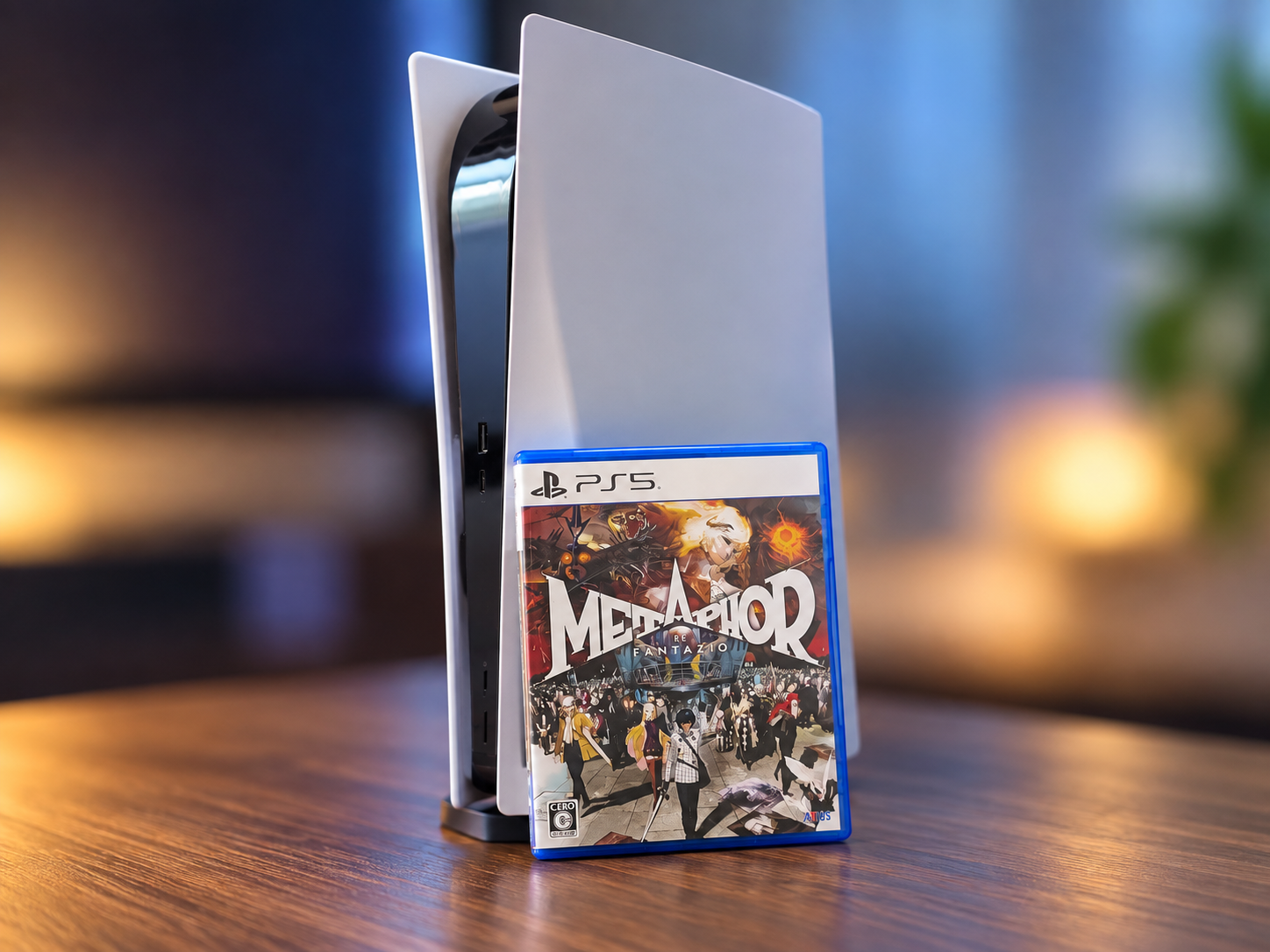
Looking for a major RPG to play on Nintendo Switch 2?
If you enjoy fantasy worlds, memorable party members, strategic turn-based combat, and stories that take their themes seriously, Metaphor: ReFantazio should be near the top of your list.
Originally released in 2024 for PlayStation, Xbox, and PC, Atlus’ acclaimed fantasy RPG is officially coming to Nintendo Switch 2 on November 12, 2026. The Japanese standard edition is priced at just ¥3,990, making it considerably more affordable than the game’s original Japanese launch price.
That lower price is important because Metaphor: ReFantazio is not a short spin-off or a smaller portable release. It is a full-scale fantasy adventure that can keep players occupied for dozens upon dozens of hours.
It is also one of the most critically acclaimed Japanese RPGs of recent years. The PlayStation 5 version holds a Metascore of 94 based on 54 critic reviews, placing it in Metacritic’s “Universal Acclaim” category.
For Nintendo players who missed the original release, the Switch 2 version may be the perfect opportunity to discover what makes this game so special.
- What Is Metaphor: ReFantazio?
- A True Fantasy Adventure
- Why Persona Fans Will Feel at Home
- You Do Not Need to Be a Persona Fan
- Strategic Turn-Based Combat With Faster Exploration
- The Archetype System Makes Character Building Addictive
- A Story About Fantasy, Fear, and Leadership
- A Party Worth Travelling With
- Why the Nintendo Switch 2 Version Matters
- The Lower Japanese Price Makes It Easier to Try
- One of the Highest-Rated RPGs of Its Generation
- How Long Does It Take?
- Is It Difficult?
- Potential Drawbacks to Consider
- Who Should Play Metaphor: ReFantazio?
- Standard Edition or Anniversary Edition?
- Is the Switch 2 Version Worth Waiting For?
- Final Verdict: A Modern Classic for JRPG Fans
- Related Posts:
What Is Metaphor: ReFantazio?
Metaphor: ReFantazio is an original fantasy RPG developed by Studio Zero and published by Atlus and Sega.
The game comes from creators associated with Persona 3, Persona 4, and Persona 5, including director Katsura Hashino, character designer Shigenori Soejima, and composer Shoji Meguro.
However, this is not a Persona spin-off.
It introduces an entirely new world, a new cast, a new mythology, and a self-contained story. You do not need to know anything about Persona, Shin Megami Tensei, or any other Atlus series before playing it.
The story takes place in the United Kingdom of Euchronia, a fantasy nation inhabited by several tribes.
After the king is assassinated, the country is thrown into chaos. The late king’s extraordinary magic then announces that the next ruler will be chosen through the support of the people.
A competition for the throne begins.
The protagonist, who initially travels with his fairy companion Gallica to save a cursed prince, becomes involved in this unprecedented royal election. He must travel across the kingdom, gain public support, confront dangerous rivals, and decide what kind of future he wants to create.
The result is an adventure that feels both familiar and unusual.
On one level, it is a classic story about a young hero gathering allies and travelling across a fantasy kingdom. On another, it is a political drama about prejudice, fear, social inequality, leadership, religion, and the power of public opinion.
A True Fantasy Adventure
Many modern RPGs take place in contemporary cities, science-fiction settings, or enormous open worlds.
Metaphor: ReFantazio proudly embraces traditional fantasy.
There are castles, travelling merchants, monsters, knights, magic, mysterious ruins, competing political factions, and an uncertain royal succession. The party travels between cities while meeting people from different backgrounds and learning more about the kingdom.
The structure recalls the appeal of classic role-playing games: leave home, meet companions, discover new towns, grow stronger, and become involved in a conflict much larger than yourself.
However, the game does not simply copy older RPGs.
Its visual identity is bold and modern. Menus move with dramatic energy, character portraits resemble illustrations from an elaborate fantasy manuscript, and the entire interface feels like an extension of the game’s world.
The soundtrack is equally distinctive. Shoji Meguro’s music does not rely only on familiar heroic orchestration. The battle themes use unusual chanting and rhythms that immediately separate Metaphor from more conventional fantasy games.
This combination allows the game to feel traditional without feeling old-fashioned.
Why Persona Fans Will Feel at Home
Although Metaphor: ReFantazio is an original fantasy title, players familiar with modern Persona games will recognize several ideas.
Time matters.
You travel through the kingdom according to a calendar, and many activities consume part of the day. You may choose to explore a dungeon, complete a request, spend time with a companion, improve one of the protagonist’s personal qualities, or prepare for the next stage of the journey.
Because time is limited, you cannot always do everything immediately.
This creates an enjoyable sense of planning. Should you enter a dungeon now, or spend the evening strengthening a relationship? Should you complete a side quest, or improve an ability that may unlock new opportunities later?
The companion system will also feel familiar to Persona fans.
As the protagonist forms bonds with important characters, he learns about their histories, problems, ambitions, and fears. Strengthening these relationships can also provide practical benefits in combat and character development.
The difference is the setting.
Instead of attending school and exploring modern Tokyo, you are travelling through a fantasy kingdom during a race for the throne. The journey feels more like a grand expedition than a year in the life of a student.
Players who love the social and scheduling systems of Persona but want a more traditional fantasy adventure may find Metaphor especially appealing.
You Do Not Need to Be a Persona Fan
It would be misleading to describe Metaphor: ReFantazio as simply “fantasy Persona.”
The game has similarities, but its identity is strong enough to stand on its own.
Its central story is not about balancing school life with supernatural investigations. It is about travelling through a divided nation and participating in a political competition that could transform the kingdom.
Its party members come from different regions, tribes, professions, and social positions. Their personal experiences are closely connected to the wider problems facing Euchronia.
The game also places more emphasis on the feeling of travelling.
Your mobile headquarters carries the party between destinations, creating opportunities for conversations, cooking, training, reading, and other activities while on the road.
This makes the experience feel like a long fantasy journey shared with a group of companions.
People who have never played an Atlus RPG can start with Metaphor without missing any important background information.
Strategic Turn-Based Combat With Faster Exploration
The battle system combines real-time field actions with turn-based combat.
When exploring a dungeon, the protagonist can attack enemies directly. Weaker enemies can sometimes be defeated quickly without entering a full command battle, which helps reduce the repetition commonly associated with traditional RPG grinding.
More dangerous enemies require proper turn-based combat.
Before the command battle begins, skillful field attacks may stun an enemy and give your party an advantage. Poor positioning, however, can allow the enemy to begin the battle in a stronger state.
Once combat starts, strategy becomes essential.
The game uses concepts familiar to fans of Atlus’ other RPGs. Hitting an enemy’s weakness can make your turns more efficient, while using an ineffective attack may waste valuable opportunities.
Boss battles often reward preparation more than brute force.
Your choice of skills, party roles, equipment, and elemental attacks can be more important than simply having a high character level. Entering a difficult battle with the wrong setup can be painful, but discovering the correct strategy is extremely satisfying.
The system creates a strong balance between speed and depth.
Routine encounters do not always interrupt exploration, while major fights retain the strategic tension expected from a turn-based Atlus RPG.
The Archetype System Makes Character Building Addictive
Instead of using traditional character classes, Metaphor: ReFantazio features a system called Archetypes.
Archetypes represent heroic roles that awaken within the characters. They function somewhat like jobs or classes in other RPGs.
Examples include warriors, knights, healers, mages, brawlers, merchants, and many more specialized roles.
Party members are not permanently locked into a single class.
You can change their Archetypes, develop different skill sets, and transfer selected abilities between roles. A character who usually acts as a physical attacker can learn supportive skills. A healer can inherit an attack or defensive ability. A party member can be redesigned to suit the needs of a particular dungeon.
This flexibility encourages experimentation.
You might build a balanced party for ordinary exploration, then completely reorganize your lineup before a difficult boss. Certain combinations also unlock powerful cooperative attacks, giving you another reason to test different party structures.
The system is deep, but it gradually introduces new options rather than presenting everything at once.
Players who enjoy job systems in games such as Final Fantasy V, Bravely Default, or Octopath Traveler are likely to appreciate the freedom offered by Archetypes.
A Story About Fantasy, Fear, and Leadership
The title Metaphor is not accidental.
Fantasy itself is one of the game’s central themes.
The characters live in a world filled with injustice, discrimination, anxiety, and violence. Some dream of a better society, but others dismiss those dreams as impossible fantasies.
The game repeatedly asks whether imagining an ideal world has any value.
Can stories inspire real change?
Can hope survive in a society controlled by fear?
Can a person become a good leader simply because they have good intentions?
These questions give the adventure more substance than a conventional battle between heroes and villains.
The protagonist is not merely trying to defeat a final enemy. He is asking the people of Euchronia to believe in a different future.
That political dimension could easily have become overly complicated or preachy. Instead, the game usually explores its ideas through individual characters and their personal experiences.
The people you meet are affected by the kingdom’s social divisions. Their stories give human meaning to the wider political conflict.
The result is an RPG that can be enjoyed as an exciting fantasy adventure while still offering plenty to think about after the credits.
A Party Worth Travelling With
A long RPG depends heavily on its cast.
Fortunately, Metaphor: ReFantazio introduces a party of characters who feel like genuine travelling companions.
They do not all come from the same town, age group, profession, or social class. Each character has a different reason for joining the protagonist, and their contrasting perspectives make conversations more interesting.
Some are driven by loyalty.
Some seek justice.
Others are attempting to overcome failure, grief, discrimination, or self-doubt.
Their stories are not isolated from the main plot. Personal struggles frequently reflect the larger themes of the kingdom.
The party’s mobile base also gives the group time to interact between major events. These quieter moments are important because they allow the companions to feel like people rather than combat units.
By the end of the journey, the party has the warmth of a group that has genuinely travelled, struggled, and grown together.
Why the Nintendo Switch 2 Version Matters
The arrival of Metaphor: ReFantazio on Nintendo Switch 2 is important for several reasons.
First, it brings the game to players who primarily use Nintendo hardware.
The original 2024 release was available on PlayStation 4, PlayStation 5, Xbox Series X|S, Windows, and Steam, but there was no Nintendo version at launch. Metacritic now lists Nintendo Switch 2 among the game’s platforms, while Nintendo has confirmed a November 12, 2026 release.
Second, this type of RPG is well suited to portable play.
Metaphor is a long game with many different activities. Some sessions may involve major boss fights, while others may consist of conversations, shopping, character development, or planning the next journey.
Being able to play on a television and then continue in handheld mode should make the game easier to fit into everyday life.
You could tackle major dungeons at home, then use shorter portable sessions to manage Archetypes, strengthen relationships, or complete smaller tasks.
For players with limited free time, that flexibility may make the difference between abandoning a 70-to-100-hour RPG and actually finishing it.
The Lower Japanese Price Makes It Easier to Try
The Japanese Nintendo Switch 2 standard edition is listed at ¥3,990. The original Japanese standard edition for other platforms launched at ¥9,878, meaning the new Switch 2 release is being introduced at a substantially lower price in Japan.
That makes the Switch 2 version especially attractive for players who were interested in the game but did not want to pay the original full price.
It is worth emphasizing that this is still the complete main game.
Players are not receiving a short side story or a reduced portable edition. They are getting the full fantasy RPG that earned widespread critical recognition.
Regional prices outside Japan may differ, so international readers should check their local Nintendo eShop before purchasing.
Even so, the lower Japanese price shows that Atlus is positioning the Switch 2 release as an accessible new entry point rather than treating it like a full-price relaunch.
One of the Highest-Rated RPGs of Its Generation
Metaphor: ReFantazio was not merely received as a good game.
It was recognized as one of the standout RPGs of 2024.
The PlayStation 5 edition has a Metascore of 94 based on 54 professional reviews. At the time of writing, its Metacritic user score is 8.5 based on thousands of ratings.
A score above 90 does not guarantee that every player will love a game. Personal preferences still matter.
However, a 94 Metascore indicates an unusually strong level of agreement among critics.
Reviews frequently praised the game’s strategic combat, fantasy world, character development, visual presentation, music, and ability to adapt familiar Atlus systems into a new setting.
That critical reputation reduces some of the risk for Nintendo players considering the new version.
This is not an unknown game launching with unanswered questions about its fundamental quality. Its story, systems, and overall design have already been tested by a large international audience.
The main question is no longer whether Metaphor is a strong RPG.
The more useful question is whether its particular style of long, story-heavy, strategic gameplay suits you.
How Long Does It Take?
Metaphor: ReFantazio is a substantial game.
A normal playthrough can take many dozens of hours, and players who complete optional quests, develop relationships, and explore thoroughly may spend around 100 hours or more with it.
This is excellent value for players who want one major RPG to enjoy over several weeks or months.
It may be less suitable for someone looking for a short game that can be completed over a weekend.
The story contains many conversations and major narrative sequences. You will spend significant time reading dialogue, learning about the world, and watching characters respond to political events.
The game is not designed for players who want nonstop combat with minimal story.
Its length can also make the calendar system feel demanding. Players who dislike making choices under time limits may occasionally feel pressure.
However, the schedule is generally generous enough to enjoy the journey without following a perfect step-by-step guide.
For a first playthrough, it is often better to make your own decisions rather than trying to optimize every day.
Is It Difficult?
Atlus games have a reputation for challenging combat, and Metaphor can punish careless decisions.
Enemies can exploit your party’s weaknesses just as you can exploit theirs. A poor opening move may put the entire group in danger, especially against powerful bosses.
However, the game provides multiple difficulty settings.
Players mainly interested in the story can choose an easier option, while experienced RPG fans can select a higher difficulty that demands careful party building.
The ability to change Archetypes also gives you many ways to respond to a difficult encounter.
When a boss seems impossible, the solution may not be hours of grinding. Changing your party’s classes, inherited skills, equipment, or formation can transform the battle.
This makes difficulty feel more like a strategic puzzle than a simple level check.
Potential Drawbacks to Consider
Despite its high scores, Metaphor: ReFantazio will not appeal to everyone.
The first issue is length.
This is a major commitment, and the game takes time to establish its world, political factions, tribes, and systems.
The second is the amount of dialogue.
Players who prefer action-focused games may find some sections too slow.
The third is visual performance.
The game’s art direction is exceptional, but its technical graphics are not always as impressive as its interface and character design. Prospective Switch 2 buyers should also wait for detailed technical analysis if frame rate and resolution are major concerns, because the final Switch 2 performance has not yet been independently evaluated as of July 28, 2026.
Finally, some players may feel that the calendar and relationship systems are too similar to Persona.
For others, those familiar mechanics are a major strength.
Understanding these points before buying will help you decide whether the game matches your preferences.
Who Should Play Metaphor: ReFantazio?
The Nintendo Switch 2 version is particularly easy to recommend to players who enjoy:
- Long, story-driven fantasy RPGs
- Strategic turn-based battles
- Flexible job and class systems
- Strong party-member development
- Political stories and social themes
- The calendar and relationship systems of Persona
- RPGs that can be played gradually in handheld mode
- Critically acclaimed games offered at a lower price
Fans of Persona 5 Royal, Shin Megami Tensei V, Final Fantasy, Dragon Quest, Fire Emblem: Three Houses, Octopath Traveler, and Bravely Default may all find something familiar to appreciate.
However, Metaphor combines those influences into a world and identity of its own.
Standard Edition or Anniversary Edition?
For most first-time players, the standard edition should be enough.
The main game already offers an enormous amount of content, including its complete story, party members, Archetype system, optional requests, and major dungeons.
A digital Atlus 35th Anniversary Edition is also available in Japan. It includes anniversary materials such as digital art and music content, as well as themed costume and battle-music sets.
Long-time Atlus fans may enjoy these extras.
New players primarily interested in experiencing the story should begin with the less expensive standard edition.
Is the Switch 2 Version Worth Waiting For?
For players who already own a powerful PC, PlayStation 5, or Xbox Series X, the answer depends on price and portability.
The game is already available on those systems, and discounted copies may be easy to find.
However, the Switch 2 version has two clear attractions:
It can be played as both a home-console and portable RPG, and its Japanese price of ¥3,990 is far below the original Japanese launch price.
Nintendo-only players have an even easier decision.
Metaphor: ReFantazio is one of the most acclaimed modern JRPGs, and the Switch 2 edition finally makes the full adventure available on Nintendo hardware.
Unless technical reviews reveal major performance problems, it should become one of the system’s most substantial role-playing games.
Final Verdict: A Modern Classic for JRPG Fans
Metaphor: ReFantazio succeeds because it respects the traditions of the genre without being trapped by them.
It offers the emotional appeal of a classic fantasy journey: a young hero, an expanding group of companions, distant cities, dangerous monsters, and a kingdom whose future hangs in the balance.
At the same time, it introduces modern pacing, striking visual design, flexible character building, meaningful scheduling decisions, and a story willing to discuss fear, prejudice, democracy, and leadership.
The real-time field combat makes ordinary exploration faster.
The turn-based battles remain strategic.
The Archetype system encourages experimentation.
The companion stories give emotional weight to the journey.
Most importantly, the game understands why fantasy matters.
It does not treat hope as childish. Instead, it asks whether people can create a better reality without first having the courage to imagine one.
With a Metascore of 94, the game has already earned a place among the most celebrated Japanese RPGs of its generation.
Its Nintendo Switch 2 release on November 12, 2026 gives a new audience the chance to experience it, while the Japanese standard price of ¥3,990 makes the decision significantly easier.
For anyone who wants a long, intelligent, visually distinctive fantasy RPG, Metaphor: ReFantazio deserves serious consideration.
The tournament for the throne is coming to Nintendo Switch 2.
This may be the best time yet to join it.
More English Articles
If you enjoy story-driven Japanese RPGs, action games, and game-related events, you may also enjoy these articles.
- Persona 5 Strikers Review – A Fast-Paced Action RPG That Still Feels Like Persona
A firsthand review of Persona 5 Strikers, including its action-focused combat, strategic elements, and how well it keeps the atmosphere of Persona 5. - Final Fantasy X 25th Anniversary Pop-Up Store in Tokyo – Is It Worth Visiting?
I visited the Final Fantasy X 25th Anniversary pop-up store in Tokyo and share the atmosphere, merchandise, and my impressions as a longtime FFX player. - San-X Paradise at Fuji-Q Highland – A New Must-Visit Destination for Japanese Character Fans
A firsthand visit to San-X Paradise at Fuji-Q Highland, with details about the shops, mini-games, atmosphere, and practical tips for visitors.