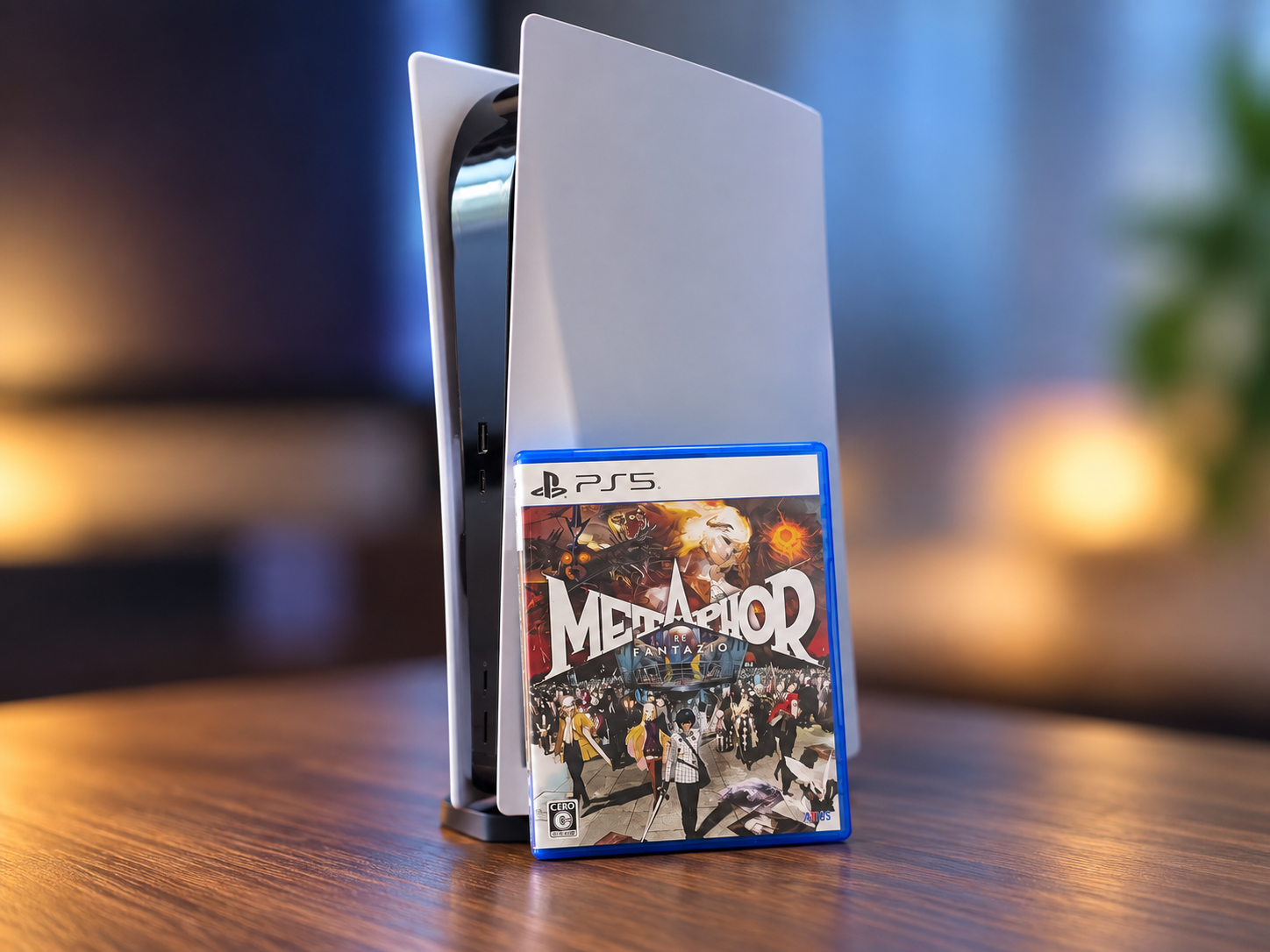
If you are looking for a long RPG to play on Nintendo Switch 2, you may have come across Metaphor: ReFantazio.
I had already finished the game before the Nintendo Switch 2 version was announced.
Before playing it, I honestly expected something close to “Persona in a fantasy world.”
After finishing it, though, that was not how I felt at all.
Metaphor certainly shares some ideas with the Persona series, including calendar-based progression, relationships with companions, and strategic turn-based combat.
But what stayed with me most was something different:
the feeling of travelling across a fantasy kingdom with a group of companions.
When I reached the ending, my first thought was:
I wish I could forget the story and experience this journey for the first time again.
That is how much I enjoyed my first playthrough.
In this review, I will focus on what I actually experienced while playing Metaphor: ReFantazio, including what I loved, what surprised me, and a few things I struggled with.
I will avoid major story spoilers.
Quick Verdict
After finishing Metaphor: ReFantazio, I would especially recommend it to players who enjoy:
- Long, story-driven JRPGs
- Travelling through different towns and regions
- Memorable party members
- Strategic turn-based combat
- Flexible job or class systems
- Persona-style calendar management
- Stories involving politics, social issues, and leadership
On the other hand, it may not suit you if you mainly want fast action, very little dialogue, or a short RPG that you can finish in a weekend.
For me, the strongest parts of the game were the journey, the companions, and the unusual idea of an election deciding the future king.
What Is Metaphor: ReFantazio?
Metaphor: ReFantazio is a fantasy RPG developed by Studio Zero and published by Atlus.
It was originally released in October 2024 for PlayStation, Xbox, Windows, and Steam.
The story takes place in the United Kingdom of Euchronia.
After the king is assassinated, the country enters a period of uncertainty. A special form of magic declares that the next king will be chosen through the support of the people.
The protagonist originally begins his journey for a much more personal reason: saving a cursed prince.
But that journey eventually brings him into the competition for the throne.
So while the game has many familiar fantasy-RPG elements—travelling, meeting companions, fighting monsters, and visiting new towns—it also revolves around something unusual for an RPG:
an election.
That became one of my favorite parts of the game.
The Election Theme Was Much More Interesting Than I Expected
Before playing, I was not sure whether an election would actually work as the central idea of a fantasy RPG.
It does.
And in my opinion, it works surprisingly well.
You are not simply travelling around the kingdom to defeat a final villain.
You are also trying to earn the trust and support of the people.
As you travel, you encounter different regions, tribes, social classes, religions, and local problems.
That means the journey itself gradually shows you what kind of kingdom you are trying to change.
I often found myself thinking things like:
“Would I actually support this candidate?”
or
“Having a good ideal is one thing, but could this person really rule a country?”
The game touches on subjects such as prejudice, inequality, religion, fear, and leadership.
However, I never felt that I needed to understand real-world politics in order to enjoy the game.
At its core, it is still a very approachable fantasy adventure.
The election simply gives that adventure a different kind of purpose.
I Loved the Feeling of Travelling With the Party
This was probably my favorite part of Metaphor.
In the modern Persona games, you usually spend most of the story around one main city and follow your daily life there.
Metaphor feels very different.
You actually travel across the kingdom.
You arrive in new towns.
You meet people with different cultures and backgrounds.
You discover new problems.
Then you leave again and continue to the next destination.
I have always enjoyed the moment in an RPG when you arrive at a completely new town and wonder:
“What kind of place is this?”
Metaphor gave me that feeling repeatedly.
The party also travels together in a mobile base, so the time between major destinations does not feel empty.
You can talk with companions, prepare for upcoming challenges, read, train, cook, and spend time together.
By the later parts of the game, I did not feel as if I simply had several combat characters in my party.
It felt more like a group of people who had genuinely been travelling together for a long time.
That made the final parts of the story much more emotional for me.
The Party Members All Felt Distinct
Another thing I appreciated was that I never felt that one party member existed only to fill a combat role.
Each companion comes from a different background.
They have different:
- tribes
- social positions
- personal problems
- motivations
- reasons for joining the journey
Because of that, every new party member made me curious.
I wanted to know:
Why did this person decide to follow the protagonist?
How do they see the kingdom differently from the others?
Their personal stories also connect naturally with the larger problems facing the country.
By the end of the game, I had grown attached to the entire group rather than only one or two favorite characters.
If you enjoy RPGs where the party gradually becomes a close group of travelling companions, I think this is one of Metaphor’s strongest points.
It Feels Familiar to Persona Fans — But It Is Not “Fantasy Persona”
I have played Persona games, so I immediately noticed the similarities.
Metaphor also uses a calendar system.
You have limited time and must decide how to spend it.
For example, you may choose to:
- Explore a dungeon
- Complete a side quest
- Spend time with a companion
- Improve one of your personal qualities
- Prepare for the next part of the journey
Because I was already familiar with Persona, I initially approached Metaphor in a very efficiency-focused way.
I kept thinking:
“I should finish as much as possible in one day.”
That mindset eventually caused one of the funniest problems in my playthrough.
More on that later.
Despite the similarities, though, Metaphor never felt like a simple fantasy reskin of Persona.
The biggest difference for me was the sense of movement.
Instead of living a school life in one city, you are constantly travelling.
For that reason, the best comparison I can make is:
Persona-style time management combined with a traditional fantasy journey.
Persona fans should feel comfortable with many of the systems, but you absolutely do not need to play Persona first.
Metaphor tells a completely independent story.
The Protagonist Talking More Was Surprisingly Refreshing
One difference I noticed quickly was the protagonist.
Persona protagonists usually speak relatively little.
They often feel like an extension of the player.
The protagonist in Metaphor speaks much more frequently.
Because of that, I felt less like:
“I am the protagonist.”
and more like:
“I am following this protagonist’s journey.”
Personally, I liked that.
The protagonist feels more like an established character within the story.
You still make dialogue choices, and some of them are surprisingly funny.
Even in a serious conversation, the game occasionally gives you a strange response option.
Whenever I saw one of those choices, I usually wanted to select it just to see how the other character would react.
Those small moments helped give the game personality.
The Combat System Was One of My Favorite Parts
Metaphor mixes real-time field attacks with traditional command-based battles.
Against weaker enemies, you can often defeat them directly while exploring.
That makes dungeon exploration much faster.
You do not need to enter a full turn-based battle every single time you encounter an enemy that is far weaker than your party.
Against stronger enemies, however, the game switches to full command combat.
And that is where strategy becomes important.
Enemies have weaknesses and resistances.
Your party members have different roles.
Your skills, equipment, formation, and Archetypes matter.
Using the wrong attack can cost you valuable actions.
Using the right weakness can give you a major advantage.
I enjoyed this balance a lot.
Weak enemies do not constantly interrupt exploration, but boss battles still require you to think.
I Ran Out of MP in the First Dungeon
This is probably the clearest example of how my Persona experience actually made my first Metaphor playthrough harder.
Because the game uses a calendar system, I assumed I should clear each dungeon as efficiently as possible.
So when I entered the first major dungeon, I thought:
“I should finish this in one day.”
The problem was that I was still early in the game.
My resources were limited.
Eventually, I ran out of MP.
Instead of simply leaving, I stubbornly tried to continue.
I used the Mage Archetype and repeatedly defeated weaker enemies to recover small amounts of MP.
Fight weaker enemies.
Recover a little MP.
Move forward.
Run out again.
Repeat.
That part became quite repetitive.
The funny thing is that after I finally progressed further, I realized the calendar was more generous than I had expected.
I probably did not need to push myself that hard at all.
So if you are a Persona player starting Metaphor, my advice is:
Do not assume that every day has to be perfectly optimized.
It is easy to create unnecessary stress for yourself.
The Archetype System Made Character Building Fun
Metaphor uses a system called Archetypes.
They function somewhat like jobs or classes in other RPGs.
There are roles based around:
- Physical attacks
- Magic
- Healing
- Defense
- Support
- Specialized abilities
What I enjoyed is that party members are not permanently locked into one role.
You can experiment.
You can develop one Archetype to learn useful skills, then inherit some of those abilities while using another Archetype.
That creates a lot of room for planning.
Sometimes I would think:
“I want this skill later, so maybe I should train this Archetype first.”
I enjoy RPG systems that let me think about character development, so this was very satisfying.
At first, the number of possibilities can look complicated.
But the game introduces the systems gradually, so I never felt completely overwhelmed.
The Game Can Be More Difficult Than It First Appears
Metaphor is not an impossibly difficult RPG, especially because it offers different difficulty settings.
But it can punish careless decisions.
One thing I learned quickly is that enemies can take advantage of your weaknesses just as effectively as you can exploit theirs.
There were battles where one bad decision caused the situation to collapse very quickly.
A boss that initially feels too difficult may become much more manageable after changing:
- Archetypes
- inherited skills
- equipment
- party members
- formation
I liked that.
The solution is not always simply to grind more levels.
Sometimes you need to rethink your setup.
For players who enjoy strategic command-based RPGs, that part is very rewarding.
The Art and Music Give the Game a Very Distinct Identity
Visually, Metaphor does not feel like an ordinary medieval fantasy RPG.
Its menus, illustrations, architecture, and UI have an almost painted or manuscript-like quality.
The interface is especially memorable.
Even opening menus feels stylish.
The music also surprised me.
Some of the battle music sounded very unusual to me the first time I heard it.
My initial reaction was almost:
“What kind of battle theme is this?”
But after hearing it repeatedly, it became difficult to imagine the battles with anything else.
That is something I appreciated about the game as a whole.
It does not simply rely on familiar fantasy aesthetics.
It creates a world that feels recognizably Atlus, but still different from Persona.
One Thing to Know Before Buying: This Is a Long Game
Metaphor is not a short RPG.
You will spend time on:
- Main-story events
- Dungeons
- Side quests
- Conversations
- Companion relationships
- Town exploration
- Archetype development
- Equipment management
There is also a lot of dialogue.
Personally, I enjoyed taking my time with the story.
But if you mainly want constant combat and minimal conversation, the pacing may feel slow.
I think Metaphor works best for someone who wants one large RPG to enjoy over several weeks or even months.
It is not the kind of game I would recommend if your main goal is finishing something quickly.
Things I Did Not Love
I enjoyed Metaphor a lot, but the experience was not perfect.
The biggest issue for me early on was MP management.
As mentioned above, I created some of that problem myself by trying to clear too much in a single day.
Still, resource management in the early game can feel restrictive.
The calendar system can also make you unnecessarily anxious if you are the type of player who wants to see everything in one playthrough.
I was definitely guilty of that.
There is also a large amount of dialogue.
That was not a major negative for me, because I play RPGs mainly for story and characters.
But players who want a faster pace should be aware of it.
Finally, although the game shares many systems with Persona, some players may feel that those elements are too familiar.
For me, the travelling structure and fantasy setting made the overall experience different enough.
Who I Think Will Enjoy Metaphor: ReFantazio
Based on my own playthrough, I would especially recommend it if you:
- Like long JRPGs
- Enjoy travelling to new towns and regions
- Care about party members and character development
- Like turn-based combat
- Enjoy experimenting with jobs or classes
- Like Persona-style scheduling
- Prefer story-heavy RPGs
- Enjoy fantasy stories that also deal with social or political themes
I would be more cautious if you:
- Mainly want real-time action combat
- Dislike long dialogue sequences
- Hate calendar systems
- Want a short game
- Do not enjoy thinking about party builds
What About the Nintendo Switch 2 Version?
The Nintendo Switch 2 version is scheduled for November 12, 2026.
In Japan, the standard physical and digital editions are priced at ¥3,990, while the Atlus Brand 35th Digital Anniversary Edition is priced at ¥5,990. Atlus has also announced early-purchase bonuses. アトラス公式サイト
Nintendo lists support for TV, tabletop, and handheld play modes for the Switch 2 version. Nintendo
For a game this long, I think handheld play has obvious appeal.
For example, I can imagine:
- Playing major dungeons on the TV
- Spending time with companions in handheld mode
- Adjusting Archetypes before bed
- Completing smaller activities during shorter sessions
However, there is one important point:
I have not played the Nintendo Switch 2 version yet.
My impressions in this article are based on finishing the game on another platform.
So I cannot personally comment yet on Switch 2-specific performance, loading times, frame rate, or image quality.
I plan to judge those separately once the Switch 2 version is actually available.
That distinction is important, especially for anyone deciding between platforms.
Is the ¥3,990 Standard Edition Enough?
For someone playing Metaphor for the first time, I think the standard edition is the obvious place to start.
The main game already offers a huge amount of content.
The Japanese Switch 2 standard edition is priced at ¥3,990, while the digital anniversary edition costs ¥5,990. アトラス公式サイト
If you mainly want to experience the story and gameplay, I do not think you need to buy the more expensive edition.
Long-time Atlus fans who want the additional digital content may prefer the anniversary version.
My Final Thoughts After Finishing Metaphor: ReFantazio
Before playing Metaphor, I thought it might simply be:
“Persona, but in a fantasy world.”
After finishing it, I no longer think that description does the game justice.
Yes, it has a calendar.
Yes, it has companion relationships.
Yes, its combat and presentation will feel familiar to Persona fans.
But what I remember most is the journey.
Travelling to a new town.
Meeting new people.
Learning about different parts of the kingdom.
Welcoming a new companion into the group.
Watching a personal mission gradually grow into something involving the future of an entire country.
The election theme also worked far better than I expected.
It gave the story a reason to show you many different parts of society instead of simply sending you from one dungeon to another.
And because the party spends so much time travelling together, I became attached to the characters by the end.
Of course, I also remember some less glamorous moments.
Running out of MP.
Repeatedly defeating weaker enemies because I was too stubborn to leave a dungeon.
Trying to optimize every single day even when I did not really need to.
Those frustrations became part of my experience too.
When I finally finished the game, I genuinely thought:
“I wish I could erase my memory and play it again for the first time.”
You can always start another playthrough.
But you only get one first journey.
For me, Metaphor: ReFantazio made that first journey memorable.
If you enjoy long fantasy RPGs, travelling with a party, strategic turn-based combat, and games that give you plenty of time to become attached to their characters, I think it is absolutely worth considering.
And for Nintendo players who missed the original release, the Switch 2 version arriving on November 12, 2026 may be an especially good opportunity to finally begin the journey
More English Articles
If you enjoy story-driven Japanese RPGs, action games, and game-related events, you may also enjoy these articles.
- Persona 5 Strikers Review – A Fast-Paced Action RPG That Still Feels Like Persona
A firsthand review of Persona 5 Strikers, including its action-focused combat, strategic elements, and how well it keeps the atmosphere of Persona 5. - Final Fantasy X 25th Anniversary Pop-Up Store in Tokyo – Is It Worth Visiting?
I visited the Final Fantasy X 25th Anniversary pop-up store in Tokyo and share the atmosphere, merchandise, and my impressions as a longtime FFX player. - San-X Paradise at Fuji-Q Highland – A New Must-Visit Destination for Japanese Character Fans
A firsthand visit to San-X Paradise at Fuji-Q Highland, with details about the shops, mini-games, atmosphere, and practical tips for visitors.